
Introduction: Why Businesses Are Turning to Software Development Outsourcing Companies
Here’s the thing every business today wants digital solutions, but not everyone can afford an in-house tech team. That’s where software development outsourcing companies come in.
They help startups, enterprises, and even agencies cut expenses, access specialized talent, and scale development without burning through their budgets.
In this post, we’ll break down exactly how outsourcing software development saves money, where the savings actually come from, and how to make the most out of it without compromising quality.
What Does a Software Development Outsourcing Company Actually Do?
A software development outsourcing company builds, maintains, and supports software projects for other businesses. Instead of hiring developers full-time, you outsource tasks or entire projects to an external team.
These companies usually offer:
- Custom software development (web, desktop, or mobile apps)
- Product design and prototyping
- Testing and quality assurance
- Maintenance and updates
- Dedicated development teams
Essentially, you’re renting expertise instead of owning it — and that’s where the cost advantage begins.
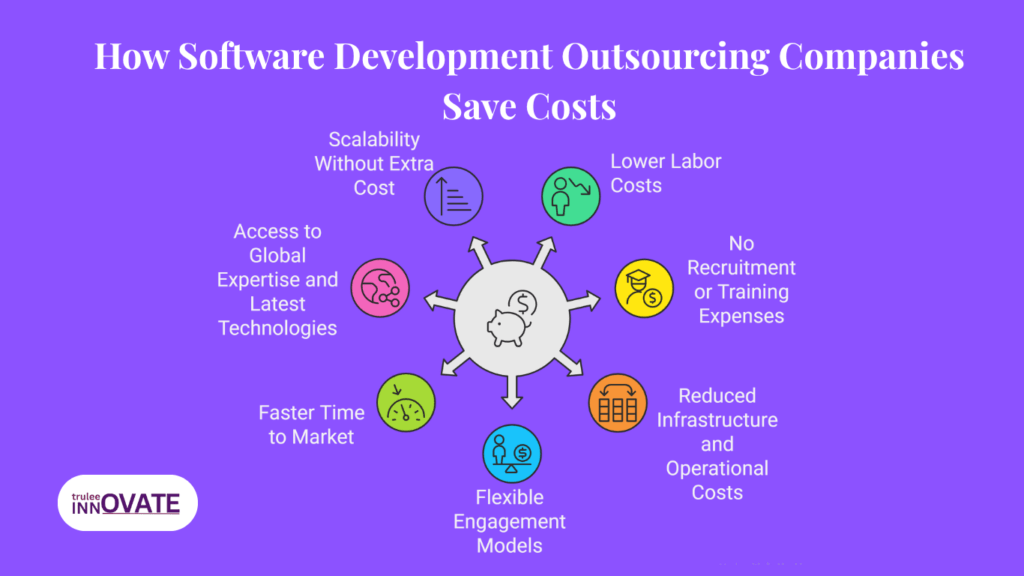
How Software Development Outsourcing Companies Save Costs
Now let’s break down the actual savings.
1. Lower Labor Costs Without Compromising Quality
Hiring full-time developers in the US or UK can be expensive. Outsourcing to countries like India, Poland, or the Philippines offers access to equally skilled developers at a fraction of the cost.
It’s not about cheap labor — it’s about cost-efficient talent.
For instance, a mid-level developer in the US might cost $90,000 annually, while an outsourced developer could cost $30,000–$40,000. Multiply that by an entire team, and the savings are huge.
2. No Recruitment or Training Expenses
Building an in-house development team means spending time and money on recruitment, onboarding, and continuous training.
Outsourcing companies already have trained professionals ready to work on your project. You skip the hiring process, HR costs, and long onboarding timelines.
What this really means: you start faster, deliver sooner, and save both time and money.
3. Reduced Infrastructure and Operational Costs
Office space, hardware, software licenses, and employee benefits — these add up quickly.
When you outsource, you don’t need to worry about equipment, workspace, or even management overhead.
Software development outsourcing companies have all the tools, testing environments, and systems in place. You pay only for the service, not the setup.
4. Flexible Engagement Models That Fit Any Budget
Outsourcing companies typically offer different pricing models:
- Fixed price (for clearly defined projects)
- Time and material (pay for actual hours worked)
- Dedicated team (hire a remote team full-time)
This flexibility means you can choose what works best for your budget and project type — no locked-in salaries, no long-term liabilities.
5. Faster Time to Market = Faster Returns
Every extra month spent developing a product in-house is a month without revenue.
With outsourcing, you have 24/7 productivity, since global teams often work across time zones.
By accelerating delivery, you reach customers faster, start generating revenue sooner, and save opportunity costs.
6. Access to Global Expertise and Latest Technologies
Hiring specialized developers (AI, blockchain, cybersecurity, etc.) locally can be costly and competitive.
Software development outsourcing companies already have skilled teams who stay updated with new frameworks, languages, and tools.
That means you don’t have to invest in expensive training programs or new software every time technology evolves.
7. Scalability Without Extra Cost
Need to expand your project team next month? Outsourcing lets you scale up or down instantly.
No extra contracts, no hiring freeze, no layoffs.
This scalability is especially useful for startups that grow quickly but unpredictably. You can increase development capacity only when needed, keeping costs flexible.
Real-World Example: How Outsourcing Saves Up to 60% of Project Costs
Let’s say a mid-size company wants to build a custom CRM system.
If they hire a full in-house team of five developers, a designer, and a QA engineer, the total yearly cost (including benefits and infrastructure) could be around $400,000–$500,000.
By outsourcing to a reliable software development outsourcing company in India, the same project could cost $150,000–$200,000, without compromising quality.
That’s a saving of up to 60%, plus faster delivery and built-in maintenance support.
How to Choose the Right Software Development Outsourcing Company
Not every vendor will fit your business. Here’s how to find a reliable one.
1. Check Portfolio and Past Projects
Look for companies that have built products similar to yours. Check their case studies, client testimonials, and live apps.
2. Evaluate Communication and Project Management
Smooth communication is non-negotiable. Make sure the company uses project management tools (like Jira, Trello, or Slack) and provides regular progress updates.
3. Assess Technical Expertise
Ask about their tech stack. A strong outsourcing partner should handle multiple technologies — from React and Node.js to cloud platforms like AWS or Azure.
4. Prioritize Security and Confidentiality
Choose a company that signs NDAs and follows data protection standards. Security is part of cost savings — one breach can undo all your efforts.
5. Compare Value, Not Just Price
Cheap doesn’t always mean better. Focus on the total value — expertise, delivery time, support — not just the hourly rate.
The Hidden Benefits Beyond Cost Savings
While cost reduction is the biggest reason to outsource, there are other gains:
- Improved focus on core business activities
- Access to innovation through global perspectives
- Better risk management due to shared responsibility
- Higher productivity via proven development frameworks
These indirect benefits often outweigh the direct cost savings in the long run.
Future of Software Development Outsourcing Companies
The outsourcing model is evolving. Companies now seek long-term tech partnerships instead of one-off projects.
We’re seeing a rise in hybrid models — part in-house, part outsourced — giving businesses the best of both worlds.
AI, automation, and agile methodologies will continue to reshape how outsourcing companies deliver value. The focus is shifting from “cheaper labor” to strategic collaboration and shared innovation.
Conclusion: Why Outsourcing is a Smart Business Move
Outsourcing isn’t just about cutting expenses — it’s about working smarter.
Software development outsourcing companies let businesses access world-class talent, speed up delivery, and control costs without compromising quality.
If you’re planning to scale, build, or modernize your digital product, outsourcing could be the smartest investment you make this year.
FAQ
1.How exactly does outsourcing software development help companies save money?
Outsourcing reduces costs by eliminating the need to hire full-time developers, invest in office infrastructure, or handle employee benefits. You only pay for the specific work or project scope, which makes budgeting more predictable.
2. Is outsourcing cheaper than building an in-house development team?
Yes, significantly. With in-house teams, you cover salaries, equipment, training, and overhead costs. Outsourcing allows you to access skilled professionals on demand—often from regions with lower labor costs—without those long-term expenses.
3.Will cost savings affect the quality of the software?
Not if you choose the right outsourcing partner. Reputed companies maintain strict quality standards, follow agile practices, and use experienced developers. The key is to evaluate portfolios, client reviews, and communication practices before signing a contract.
4. What are the hidden costs to watch out for in software outsourcing?
Hidden costs can include poor project management, unclear requirements, or frequent scope changes. To avoid them, define deliverables upfront, maintain transparent communication, and choose a vendor with a proven project management process.
5. Can small businesses or startups also benefit from outsourcing?
Absolutely. Startups often have limited budgets and need quick development cycles. Outsourcing gives them access to expert talent, advanced tools, and scalability—without spending heavily on building an internal tech team.
6. How do companies ensure data security when outsourcing software development?
Reliable outsourcing firms use NDAs, encrypted communication, secure servers, and strict access control. Always verify their data protection policies and ensure compliance with regulations like GDPR or ISO standards.