
Introduction
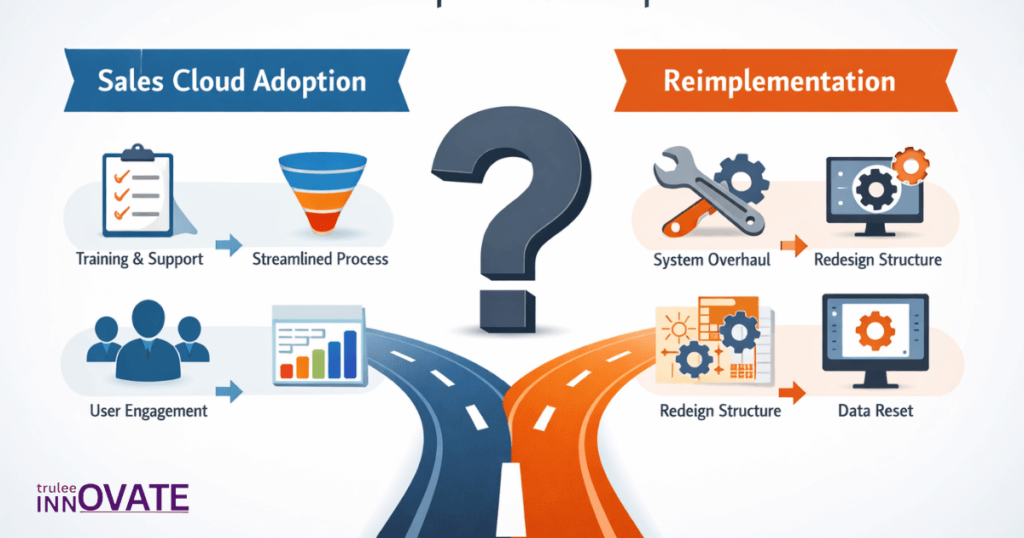
Choosing between sales cloud adoption vs reimplementation is one of the most common challenges teams face after Salesforce go live. When usage drops, data becomes unreliable, and sales teams lose trust in the system, the real question is not whether Salesforce failed, but whether the issue is poor adoption or a flawed implementation. Making the right call early prevents repeated crm adoption problems and protects long term revenue performance.
When Improving Sales Cloud Adoption Is Enough
Not every struggling Salesforce setup needs a full reimplementation. In many cases, the foundation is solid, but adoption is weak because Salesforce is not fully aligned with how the sales team works.
If Sales Cloud is being used inconsistently rather than ignored completely, improving adoption is often the right fix.
Salesforce Is Being Used, Just Not Consistently
When reps log into Salesforce, update some opportunities, and rely on it during certain stages of the sales cycle, the system itself is not the core problem. The issue is usually friction, unclear processes, or lack of reinforcement.
These are classic signs of sales cloud adoption issues that can be resolved without rebuilding everything.
The Sales Process Is Still Relevant to the Business
If the current pipeline stages broadly reflect how deals move from lead to close, reimplementation may do more harm than good. Minor adjustments and simplification often unlock better usage and data quality.
In this situation, focusing on salesforce user adoption delivers faster results than starting over.
Data Structure and Integrations Are Mostly Working
When reports, dashboards, and integrations function correctly but suffer from inconsistent data input, adoption improvement should be the priority. Reimplementing Sales Cloud in this case wastes time and budget without addressing the real problem.
Here, better training, clearer expectations, and leadership usage are the right levers.
When Reimplementation Becomes the Better Option
Salesforce Was Built Without a Clear Sales Process
If Sales Cloud was implemented before defining how the sales team actually sells, adoption fixes will not hold. When stages, objects, and workflows do not reflect reality, users struggle to understand how to use Salesforce correctly.
In this case, improving adoption alone will not solve the problem.
Pipeline Stages Do Not Match Real Deal Progression
When opportunities jump stages, move backward, or sit stuck without clear meaning, the pipeline itself is broken. This leads to poor forecasts, low trust in data, and ongoing crm adoption problems.
Reimplementation becomes necessary when the pipeline structure cannot support accurate selling or reporting.
Salesforce Customization Has Created More Confusion Than Clarity
Over time, excessive customization often makes Sales Cloud harder to use. Fields, validations, and automations added without user input create friction instead of value.
When simplification requires undoing large parts of the system, reimplementation is usually the cleaner path.
Adoption Efforts Have Failed Repeatedly
If training, process tweaks, and leadership pressure have already been tried and adoption still drops, the issue is structural. At this point, forcing usage only increases resistance.
This is a strong signal that Sales Cloud needs to be rebuilt with adoption at the core.
Common Mistakes Companies Make When Choosing the Wrong Path
When Sales Cloud adoption struggles, many teams rush into a decision without fully understanding the root problem. Choosing the wrong fix often makes adoption worse and increases long term costs.
Here are the most common mistakes companies make.
Forcing Adoption on a Broken Salesforce Setup
Leadership often assumes low usage is a discipline problem. They push stricter rules, more mandatory fields, and stronger enforcement. If the system itself is poorly designed, this approach only frustrates users and accelerates resistance.
You cannot force adoption on a system that does not support selling.
Reimplementing Salesforce Without Fixing Sales Behavior
Some teams rebuild Sales Cloud hoping a fresh start will solve everything. If sales processes, coaching habits, and accountability remain unchanged, the same adoption problems return after go live.
Technology cannot fix behavior on its own.
Over Customizing Instead of Simplifying
In an attempt to meet every edge case, Salesforce becomes overloaded with fields, automations, and validations. This complexity slows users down and creates confusion.
Strong sales cloud adoption improves through simplification, not customization.
Making the Decision Without Input From Sales Teams
Decisions made in isolation often miss real workflow problems. When sales teams are not involved, changes feel imposed rather than helpful.
This disconnect is a frequent cause of repeated crm adoption problems.
How to Evaluate Your Current Sales Cloud Setup
Before deciding between improving adoption or reimplementation, teams need an honest assessment of how Sales Cloud is performing today. This evaluation should focus on usage, trust in data, and alignment with real sales activity.
Here are the key areas to review.
Check How Salesforce Is Used in Daily Sales Work
Look at where Salesforce shows up in the sales cycle. Is it used to manage deals, or only updated at the end of the week. If reps rely on other tools to move opportunities forward, adoption is already at risk.
Consistent daily usage is a stronger signal than login metrics.
Assess Trust in Pipeline and Forecast Data
Ask leadership a simple question. Do you trust the Salesforce forecast without manual adjustments. If the answer is no, the issue is not reporting. It is how Salesforce is being used.
Low trust in data often points to deeper sales cloud adoption issues.
Review Manager Behavior and Coaching Practices
Salesforce adoption follows manager behavior. If pipeline reviews, deal inspections, and coaching sessions happen outside Salesforce, usage will decline.
Managers should be evaluated as closely as reps when assessing adoption health.
Identify Repeated Friction Points From Sales Teams
Pay attention to where users complain or avoid updates. These friction points reveal misalignment between Salesforce design and real selling behavior.
Ignoring this feedback leads to long term crm adoption problems.
What the Right Decision Looks Like for Long Term Adoption
The right choice between improving adoption and reimplementation is not about fixing Salesforce quickly. It is about building a system that sales teams will actually use over time.
A strong decision aligns technology, process, and behavior.
Salesforce Supports Selling, Not Just Reporting
In a healthy setup, Salesforce helps reps prioritize deals, track progress, and move opportunities forward. When the system adds clarity instead of friction, adoption becomes natural rather than forced.
Long term sales cloud adoption depends on usefulness, not enforcement.
Processes Are Simple, Clear, and Consistently Applied
Sales stages, required fields, and workflows should be easy to understand and consistently followed. Complexity creates hesitation, while clarity builds trust.
Whether you optimize or reimplement, simplicity is a non negotiable factor.
Leadership Uses Salesforce as the Source of Truth
When leadership relies on Salesforce for pipeline visibility and forecasting, the rest of the organization follows. Usage improves when decisions are made from Salesforce data, not spreadsheets or offline reports.
This behavior is critical for preventing recurring crm adoption problems.
Adoption Is Treated as an Ongoing Effort
Long term success comes from continuous improvement. Feedback from sales teams, regular reviews, and small adjustments keep Salesforce aligned with evolving sales motions.
Adoption does not end at go live.
How Expert Guidance Changes the Outcome
Deciding between improving Sales Cloud adoption and reimplementation is not always clear from the inside. Teams are often too close to the system to see where the real breakdown is happening. This is where experienced guidance makes a measurable difference.
Faster Clarity on the Real Problem
Experts quickly identify whether adoption issues stem from process design, system structure, or behavior. This prevents wasted time on fixes that do not address the root cause.
Clear diagnosis leads to faster results.
Avoiding Costly Trial and Error
Without guidance, teams often cycle through training sessions, configuration changes, and enforcement tactics with little improvement. Expert involvement reduces this back and forth by applying proven patterns that work across sales organizations.
This approach protects both budget and momentum.
Adoption Is Built Into the Solution From the Start
Whether improving adoption or reimplementing, expert guidance ensures Salesforce is designed around real sales behavior. Adoption is considered during design, not treated as a problem to fix later.
This is what creates long term stability.
Stronger Alignment Between Sales, Ops, and Leadership
External perspective helps align stakeholders around a single direction. Clear ownership, shared expectations, and measurable outcomes reduce friction and increase accountability.
This alignment is often the missing piece in failed adoption efforts.
Conclusion: Choosing Between Sales Cloud Adoption vs Reimplementation
Choosing between sales cloud adoption vs reimplementation is one of the most critical decisions teams make after Salesforce go live. The wrong choice leads to repeated crm adoption problems, frustrated users, and unreliable pipeline data. The right choice creates clarity, consistency, and long term Salesforce usage.
Sales cloud adoption improvements work when Salesforce is structurally sound but poorly aligned with daily sales behavior. Reimplementation becomes necessary when the system itself is broken, over customized, or built without a clear sales process. Understanding the difference between sales cloud adoption vs reimplementation prevents wasted effort and repeated failures.
Sales Cloud should support selling, not slow it down. When adoption is designed intentionally or rebuilt correctly, Salesforce becomes a system sales teams trust and actually use..
Call to Action
If you are unsure whether to fix adoption or reimplement Sales Cloud, start with a clear assessment. Understanding where the breakdown truly exists is the fastest way to stop lost time, frustrated users, and unreliable data.
Getting the decision right early saves far more than trying to fix the wrong problem later.
Frequently Asked Questions About Sales Cloud Adoption vs Reimplementation
1. How do I know if my Sales Cloud problem is adoption or implementation
If Salesforce is being used inconsistently but the sales process still makes sense, the issue is usually adoption. If users are confused about stages, data cannot be trusted, and fixes do not stick, implementation is likely the problem.
2. Can Sales Cloud adoption issues be fixed without reimplementing Salesforce
Yes. Many sales cloud adoption issues can be resolved by simplifying processes, improving training, and aligning Salesforce with how sales teams actually work.
3. When is reimplementation the right choice for Sales Cloud
Reimplementation is the right choice when Salesforce was built without a defined sales process, over customized, or repeatedly fails to support accurate forecasting and reporting.
4. How long does it take to improve Salesforce adoption
Adoption improvements often begin within weeks when friction is removed and managers actively use Salesforce. Long term adoption requires ongoing reinforcement and alignment.
5. What role do managers play in Salesforce adoption
Managers are critical to Salesforce adoption. When they use Salesforce for coaching, pipeline reviews, and forecasts, reps follow. When they do not, adoption declines quickly.
6. How do I decide between sales cloud adoption vs reimplementation
The decision between sales cloud adoption vs reimplementation depends on whether Salesforce is fundamentally usable. If users understand the system but avoid it, adoption is the issue. If the system itself causes confusion, reimplementation is often required