Introduction
Choosing an IT outsourcing partner is one of the most critical decisions startups and SMBs make when scaling their business. Many companies turn to IT outsourcing services to reduce costs and move faster, but real results depend on how carefully the partner is evaluated, not how quickly a contract is signed.
Outsourcing often looks simple. Shortlist vendors, compare prices, and start development. In reality, choosing the wrong IT outsourcing partner leads to communication breakdowns, poor quality, missed deadlines, security risks, and long-term dependency issues that are difficult to undo.
This guide is written for startups, SMBs, CTOs, and business leaders who want to understand what factors to evaluate when selecting an IT outsourcing partner, what mistakes to avoid, and how to choose based on delivery capability rather than promises or pricing alone.
This page is designed to help businesses actively evaluate and choose the right IT outsourcing partner based on delivery capability, accountability, and long-term fit. It goes beyond theory and provides a practical decision framework to support confident IT outsourcing partner selection.
Why Choosing the Right IT Outsourcing Partner Matters
IT outsourcing is no longer just about saving money. It directly affects how fast you ship, how stable your systems are, and how well your product evolves over time.
A strong outsourcing partner operates as an extension of your internal team. The wrong partner creates delays, increases management overhead, and introduces long-term risk that slows growth instead of supporting it.
Impact on Cost, Delivery, and Quality
Choosing the wrong IT outsourcing partner rarely reduces costs in the long run.
Lower hourly rates are often offset by rework, miscommunication, inconsistent delivery, and frequent team changes. A reliable outsourcing partner focuses on delivery outcomes, technical stability, and predictable execution rather than hours logged.
How to Choose the Right IT Outsourcing Partner for Your Business
Choosing the right IT outsourcing partner requires a structured evaluation process, not a quick vendor comparison. Businesses should assess partners based on delivery ownership, communication maturity, scalability, security practices, and long-term alignment rather than pricing alone.
Key Factors Startups and SMBs Should Evaluate When Choosing an IT Outsourcing Partner
Startups and SMBs face different constraints than large enterprises. Limited budgets, aggressive timelines, and fast-changing requirements make the choice of an IT outsourcing partner even more critical. These factors form the foundation of an effective IT outsourcing partner selection process and help businesses choose the right partner for long-term success.
Before committing to any provider, evaluate these core factors.
Business Understanding Over Technical Buzzwords
A reliable IT outsourcing partner understands your business goals, not just your tech stack. They should ask why features matter, how success is measured, and what trade-offs make sense for your stage of growth.
Delivery Ownership and Accountability
Many outsourcing providers execute tasks. Strong partners take ownership of outcomes. They plan delivery, flag risks early, and stay accountable for timelines and quality instead of shifting responsibility back to your internal team.
Scalability Without Operational Chaos
Startups and growing businesses need teams that scale smoothly. Evaluate how the partner adds or reduces resources, maintains team stability, and preserves knowledge as the project evolves.
Communication and Decision-Making Speed
Slow communication kills momentum. Clear reporting, defined points of contact, and fast decision cycles matter more than fancy tools.
Security, IP Protection, and Risk Awareness
Even early-stage startups handle sensitive data. Your outsourcing partner should clearly explain how data security, access control, and intellectual property ownership are handled from day one.
Evaluating these factors early prevents most long-term outsourcing failures.
Criteria That Actually Determine Long-Term Outsourcing Success
This is the core of the decision-making process. If you evaluate outsourcing partners only on cost or portfolio size, you are missing the point.
Here are the factors that actually determine long-term success.
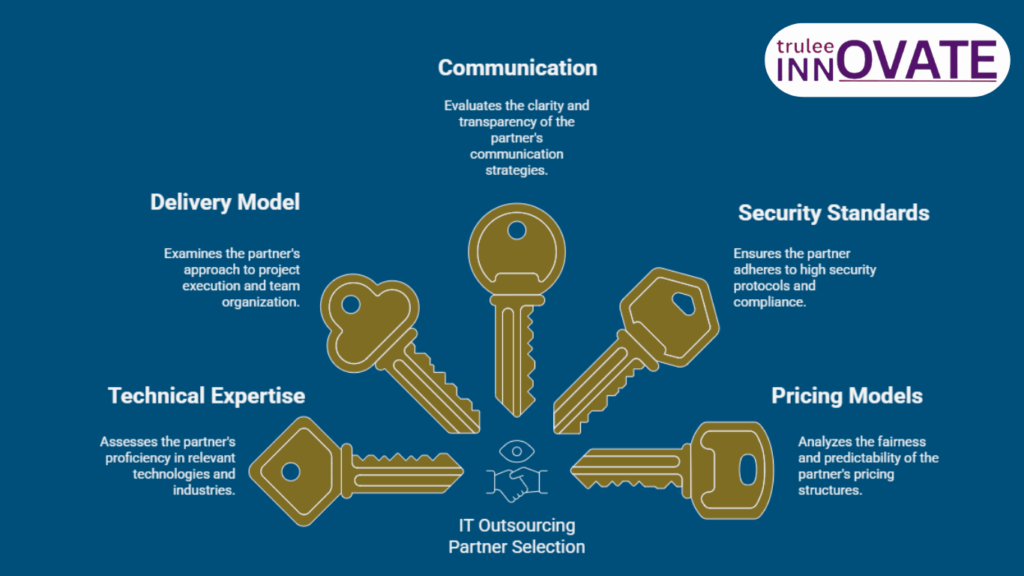
Technical Expertise and Domain Experience
Not all technical experience is equal.
A strong IT outsourcing partner does not just know programming languages. They understand your domain. A fintech product has different challenges than a healthcare platform. A SaaS startup has different priorities than an enterprise system.
What to verify:
- Experience with similar business models
- Understanding of scalability and performance requirements
- Ability to suggest better approaches, not just execute instructions
Ask them how they solved problems in past projects, not just what technologies they used.
Delivery Model and Team Structure
One of the most overlooked factors is how the outsourcing team is structured.
Common models include:
- Dedicated teams
- Project-based teams
- Hybrid engagement models
A dedicated team works best for long-term development and evolving products. Project-based models suit fixed-scope requirements. A good IT outsourcing partner helps you choose the model that fits your stage, not what is easiest for them to sell.
Also check:
- Team stability
- Senior-to-junior ratio
- Availability of architects and technical leads
Communication Process and Transparency
Many outsourcing failures come down to poor communication.
Clear processes matter more than tools.
Look for:
- Defined communication channels
- Regular status updates
- Clear escalation paths
- Honest reporting, even when things go wrong
If a partner avoids difficult conversations early, expect bigger problems later.
A reliable IT outsourcing partner values transparency over appearing perfect.
Security Standards and Compliance Practices
Security is not optional. Especially if your product handles customer data, payments, or proprietary information.
Ask about:
- Data protection policies
- Access controls
- NDA and IP ownership clauses
- Compliance standards relevant to your industry
If security discussions feel vague or rushed, treat that as a red flag.
Pricing Models and Cost Predictability
Cost matters, but predictability matters more.
A good IT outsourcing partner explains:
- How pricing works
- What is included and what is not
- How scope changes are handled
- How future scaling impacts cost
Avoid partners who quote unrealistically low prices upfront and renegotiate later. Sustainable partnerships are built on clarity, not surprises.
Questions to Ask Before Finalizing an IT Outsourcing Partner
Before signing any agreement, ask direct questions. How they answer matters more than the answers themselves.
How Do You Manage Ownership and Accountability?
Who is responsible if something breaks?
Who ensures deadlines are met?
Who reviews code quality?
You want clear ownership, not shared responsibility that leads to blame-shifting.
What Does Your Onboarding and Knowledge Transfer Look Like?
Smooth onboarding reduces ramp-up time and mistakes.
Ask how they:
- Understand your product and goals
- Document systems and workflows
- Transition knowledge between team members
This shows how mature their delivery process really is.
How Do You Handle Scale, Changes, and Risks?
Your requirements will evolve. That is normal.
A strong IT outsourcing partner:
- Plans for scale
- Handles change requests without friction
- Flags risks early instead of reacting late
Rigid partners struggle as soon as things change.
Common Mistakes Businesses Make When Choosing an Outsourcing Partner
Learning from common mistakes can save months of frustration.
Choosing Based on Cost Instead of Capability
The cheapest option often becomes the most expensive one over time.
Low cost usually means:
- Junior-heavy teams
- Limited ownership
- Higher long-term maintenance effort
Cost should be evaluated alongside experience, quality, and delivery maturity.
Ignoring Communication and Time Zone Alignment
Even small time zone overlaps make a difference.
Daily or frequent collaboration is hard if communication windows are unclear. Make sure working hours, response expectations, and meeting schedules are defined upfront.
Not Defining Success Metrics Early
Without clear success metrics, expectations drift.
Define:
- Delivery milestones
- Quality benchmarks
- Performance indicators
This protects both sides and keeps the partnership healthy.
Signals That Separate Reliable Outsourcing Partners From Risky Ones
Many businesses ask the same question before outsourcing: How do I know if an IT outsourcing partner is reliable?
There is no shortcut, but there are clear signals.
A reliable partner:
- Explains trade-offs instead of overpromising
- Shares realistic timelines and delivery risks
- Provides consistent team members, not rotating resources
- Offers references or case examples with context, not just logos
- Is transparent about pricing, scope changes, and limitations
Unreliable partners focus heavily on low pricing, vague commitments, and quick sign-offs. Reliability shows up in how problems are handled, not how sales pitches sound.
This evaluation approach matters more than recommendations alone.
IT Outsourcing Partner vs Vendor: Understanding the Difference
Understanding this difference is essential when choosing an IT outsourcing partner for long-term delivery and growth.
Businesses focused on scale usually benefit more from IT outsourcing services for growth than from short-term vendor-based engagements.This distinction matters more than people realize.
A vendor executes tasks.
An IT outsourcing partner shares responsibility for outcomes.
Partners:
- Question assumptions
- Suggest improvements
- Think long-term
Vendors:
- Follow instructions
- Optimize for short-term delivery
- Focus on contract boundaries
For growth-focused businesses, partnership always wins.
Real-World Scenarios: How the Right Outsourcing Partner Changes Outcomes
These are realistic but simplified examples.
Startup scaling with a dedicated outsourcing partner
For early-stage companies, IT outsourcing for startups offers flexibility, faster execution, and access to experienced teams without long-term hiring risk.Growing Your Startup with a Committed Outsourcing Partner
A SaaS startup had to swiftly develop and expand its platform. They opted for a specialized IT outsourcing partner rather than employing locally.
The partner assigned a reliable team, assisted in defining architecture, and coordinated development with product objectives. Faster releases, predictable costs, and the capacity to grow without internal hiring pressure were the outcomes.
Growing Business Reducing Costs with the Right Model
A mid-sized company struggled with rising in-house development costs. By switching to a hybrid outsourcing model, they retained core strategy internally and outsourced execution.
This reduced costs while maintaining quality and control.
How Truleeinnovate Helps Businesses Choose the Right Outsourcing Model
Selecting the best IT outsourcing partner is not about putting companies into inflexible bundles.
The priorities of TruleeInnovate are:
- Prioritizing an understanding of company objectives
- Aligning growth stages with engagement models
- Creating dependable, responsible teams
- Preserving openness on cost and delivery
Long-term value is given precedence over short-term contracts in this method.
Final Checklist for Selecting an IT Outsourcing Partner
Use this checklist as a final validation step before choosing an IT outsourcing partner for your business
Use this checklist before making a decision:
- Proven experience in your domain
- Clear communication and reporting process
- Transparent pricing and engagement model
- Strong security and compliance practices
- Ability to scale with your business
- Ownership mindset, not vendor behavior
If most boxes are checked, you are likely on the right path.
Evaluating the best IT outsourcing company means looking beyond pricing and focusing on delivery process, accountability, and long-term fit.
When You Are Ready to Choose an IT Outsourcing Partner
You are ready to move forward with an IT outsourcing partner when your requirements are clearly defined, delivery predictability matters more than experimentation, and accountability is non-negotiable.
At this stage, the right partner should demonstrate ownership, transparency, and a clear delivery process rather than focusing only on pricing or speed. Choosing based on these factors reduces long-term risk and creates a stable foundation for growth.
Conclusion
Choosing the right IT outsourcing partner is not a procurement task. It is a strategic decision.
Take the time to evaluate properly. Ask hard questions. Look beyond price tags. When done right, IT outsourcing becomes a growth multiplier instead of a risk.
FAQs
What factors should a startup evaluate when selecting IT outsourcing services?
Startups should evaluate technical expertise, delivery ownership, communication processes, scalability, security practices, and cost predictability. The goal is long-term delivery reliability, not short-term savings.
What should startups consider when choosing an outsourced IT provider?
Startups should consider how well the provider understands their business model, handles changing requirements, communicates progress, and scales teams without losing quality or accountability.
What are the key factors SMBs should consider when choosing an IT outsourcing partner?
SMBs should focus on domain experience, transparency in pricing, team stability, security standards, and the partner’s ability to act as an extension of their internal team.
How do I identify a reliable IT outsourcing partner?
Reliability is demonstrated through consistent delivery, clear ownership, honest communication, realistic commitments, and proven experience with similar business challenges.
Is IT outsourcing suitable for startups and growing businesses?
Yes. IT outsourcing allows startups and SMBs to access experienced teams, control costs, and scale faster without the risk of long-term hiring commitments.