
Introduction
Most small business owners know they need digital marketing, but struggle to decide where to focus their time and budget. With SEO, social media, ads, and content all competing for attention, it’s easy to invest effort into tactics that don’t deliver real results.
This guide is built for small businesses that want a clear, practical digital marketing strategy for small businesses, not scattered advice. It explains how to prioritize the right channels, build online visibility, and drive consistent results without a large budget or a big team.
If you’re looking for shortcuts or enterprise-level tactics, this guide isn’t for you. But if you want a realistic strategy you can execute step by step, you’re in the right place.
What Digital Marketing Actually Means for Small Businesses
For small businesses, digital marketing is not about being everywhere online. It’s about choosing the right channels, focusing on what brings results, and using limited resources efficiently.
Unlike large companies, small businesses don’t have the budget or team to experiment endlessly. That’s why a clear digital marketing strategy matters. It helps you decide where to invest time, which platforms to prioritize, and how to attract customers without wasting money.
When done right, digital marketing allows small businesses to:
- Reach the right audience instead of chasing everyone
- Compete with larger brands through focus, not spend
- Build visibility and trust over time
- Drive consistent leads or sales from selected channels
The goal isn’t to use every digital platform. The goal is to use the right ones, based on your business model, audience, and resources.

Key reasons why digital marketing matters:
- It is cost-effective compared to traditional marketing.
- It enables precise targeting of specific demographics.
- It provides measurable results through analytics.
With customers, it establishes a direct channel of communication.
How Small Businesses Can Compete Using Focused Digital Marketing Strategies
Small businesses don’t compete with larger companies by spending more. They compete by being more focused.
Digital marketing levels the field when small businesses choose strategies that play to their strengths instead of copying big brands. The advantage comes from targeting specific audiences, solving clear problems, and using data to improve results quickly.
A focused digital marketing strategy helps small businesses compete by:
- Targeting niche audiences instead of broad markets
- Using SEO to capture high-intent searches rather than chasing visibility everywhere
- Building trust through consistent content and communication
- Adjusting campaigns quickly based on performance data
The goal isn’t to outspend larger competitors. It’s to out-position them by being clearer, faster, and more relevant to the right customers.
Key Digital Marketing Strategies for Small Businesses
Small businesses don’t need to use every digital marketing channel. The key is choosing the strategies that align with your goals, audience, and available resources. Below are the core digital marketing strategies small businesses should focus on, along with guidance on when and why to use each one.
Search Engine Optimization (SEO)
SEO helps small businesses attract customers who are actively searching for their products or services. It’s a long-term strategy that works best when you focus on specific, high-intent keywords rather than broad competitive terms. For small businesses, SEO is most effective when combined with quality content and local optimization.
Social Media Marketing
Social media works best when used to support brand visibility and customer engagement rather than direct sales. Small businesses should focus on one or two platforms where their audience is already active instead of spreading efforts thin across multiple channels.
Pay-Per-Click Advertising (PPC)
PPC allows small businesses to generate quick traffic and leads, but it requires careful targeting and budget control. It works well for time-sensitive campaigns or validating offers, but should be used strategically to avoid unnecessary spending.
Content Marketing
Content marketing helps build trust and authority over time. Blogs, videos, and guides should focus on solving real customer problems and supporting SEO and social media efforts rather than chasing traffic alone.
Email Marketing
Email marketing is one of the most cost-effective ways for small businesses to maintain relationships and drive repeat business. It works best when used for nurturing leads, sharing valuable updates, and promoting relevant offers.
Local SEO
Local SEO is essential for businesses serving a specific geographic area. Optimizing your Google Business Profile, local keywords, and reviews helps attract nearby customers who are ready to take action.
What Small Businesses Gain From a Clear Digital Marketing Strategy
Digital marketing delivers results for small businesses only when it’s guided by a clear strategy. Instead of chasing visibility everywhere, a structured approach helps businesses focus on outcomes that actually support growth.
A well-defined digital marketing strategy helps small businesses:
- Increase visibility among the right audience rather than broad, low-intent traffic
- Use marketing budgets efficiently by prioritizing channels with measurable returns
- Target customers based on behavior, location, and intent
- Track performance and improve results using real data, not assumptions
- Build long-term trust and credibility through consistent, value-driven content
The real benefit isn’t using digital marketing tools. It’s using them with purpose.
How to Choose the Right Digital Marketing Approach for Your Small Business
Choosing the right digital marketing strategy comes down to clarity, not complexity. Small businesses get better results when decisions are guided by clear goals, audience behavior, and available resources.
Start by defining your primary objective. Whether the goal is lead generation, sales, or long-term visibility, this decision determines which channels matter and which can be ignored.
Next, understand where your audience actually spends time online. A local service business and an ecommerce brand will not use the same platforms, and treating them the same leads to wasted effort.
Set a realistic budget and timeline. Some strategies, such as SEO and content marketing, take time to show results, while others like paid advertising work faster but require tighter cost control.
Finally, choose one or two core channels and commit to them. Monitor performance regularly, track what’s working, and make adjustments based on data rather than assumptions..
How SEO Fits Into a Practical Digital Marketing Strategy for Small Businesses
SEO is one of the most effective long-term strategies for small businesses because it targets customers who are actively searching for solutions. Unlike paid channels, SEO focuses on building consistent visibility over time rather than quick spikes in traffic.
For small businesses, SEO works best when it’s focused on high-intent searches, local visibility, and clear service or product pages. The goal isn’t to rank for everything, but to be found for the searches that actually lead to inquiries or sales.
When used as part of a broader digital marketing strategy, SEO helps small businesses:
- Attract qualified traffic with clear intent
- Build trust through consistent visibility
- Reduce dependency on paid advertising over time
SEO is not a quick win, but it is a foundational strategy that supports sustainable growth when executed with focus and patience.
When and How Small Businesses Should Use PPC Advertising
PPC advertising is useful for small businesses that need faster results or want to validate offers quickly. Unlike SEO, PPC works immediately, but only when campaigns are tightly controlled.
Small businesses should use PPC when:
- There is a clear offer or service to promote
- Keywords or audiences show strong purchase intent
- Budgets are limited but focused
Platforms like Google Ads and Facebook Ads allow small businesses to control spending, target specific locations or demographics, and measure results in real time.
PPC should not replace long-term strategies. It works best as a supporting channel while SEO and content build sustainable visibility.
Using Email Marketing to Support Long-Term Customer Retention
Email marketing works best for small businesses that already have leads or customers. Its role is not discovery, but retention, trust, and repeat business.
Small businesses should use email marketing to:
- Nurture leads after initial contact
- Keep existing customers engaged
- Promote relevant offers without relying on ads
Tools like Mailchimp and Constant Contact make execution easier, but results depend on consistency and relevance, not the tool itself.
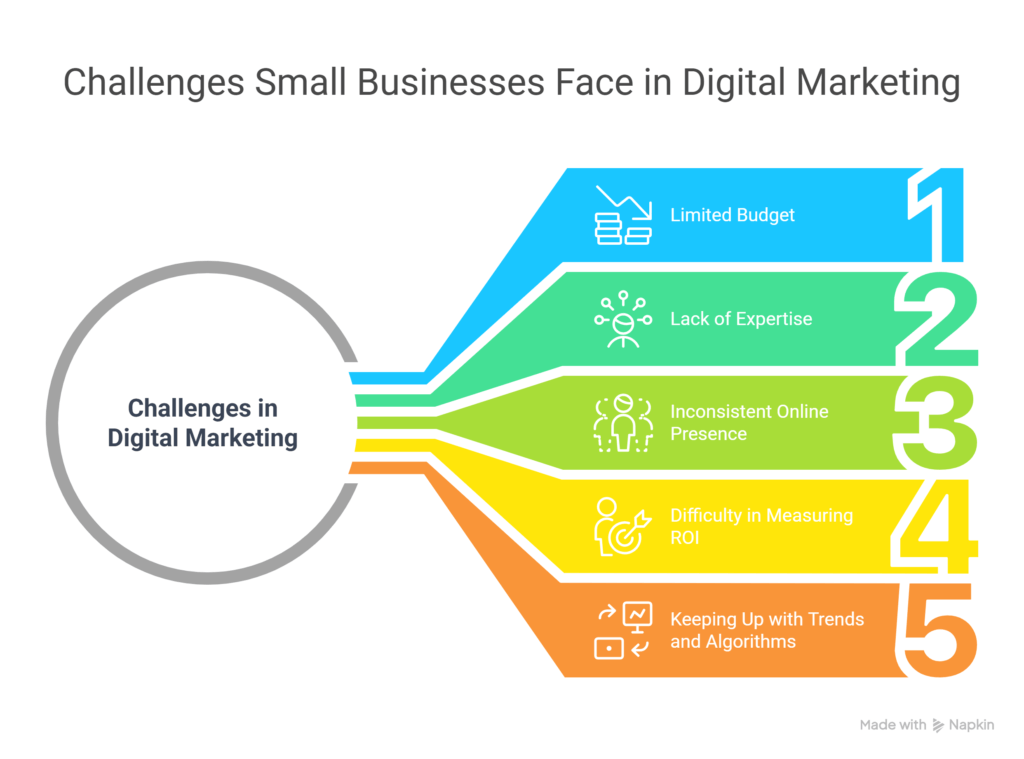
Challenges Small Businesses Face in Digital Marketing and How to Overcome Them
Digital marketing creates real opportunities for small businesses, but it also comes with constraints that larger companies don’t face. Understanding these challenges upfront helps avoid wasted effort and unrealistic expectations.
Limited Budget
Challenge: Small businesses can’t compete with larger brands on ad spend alone.
Solution: Prioritize organic strategies like SEO, content, and focused social media efforts. These take longer but deliver stronger returns over time when executed consistently.
Lack of Expertise
Challenge: Many small businesses struggle to decide where to start or how to execute campaigns effectively.
Solution: Focus on mastering the basics before expanding. Start with one or two channels, learn how performance is measured, and scale only after results are clear.
Inconsistent Online Presence
Challenge: Irregular posting and unclear messaging reduce visibility and trust.
Solution: Use a simple content calendar and maintain a consistent message across chosen platforms. Consistency matters more than frequency.
Difficulty Measuring ROI
Challenge: It’s often unclear which marketing efforts are driving results.
Solution: Track performance using tools like Google Analytics and Facebook Insights. Measure leads, conversions, and engagement rather than vanity metrics.
Keeping Up With Changes
Challenge: Platforms and algorithms change frequently, making it hard to keep up.
Solution: Avoid chasing every new trend. Focus on proven strategies, test changes gradually, and adjust only when data shows a clear impact.
By addressing these challenges with a focused and realistic approach, small businesses can build digital marketing strategies that are sustainable and effective over time.
How Small Businesses Have Used Digital Marketing Successfully
Practical examples help show how digital marketing strategies work in real situations when applied with focus.
- Local Boutique: Increased sales by focusing on targeted social media ads aimed at nearby customers instead of broad campaigns.
- Family-Owned Cafe: Improved foot traffic by optimizing local search visibility and maintaining an active local business profile.
- Handmade Crafts Business: Expanded beyond local markets by using content marketing and SEO to attract customers searching for niche products.
These examples show that results don’t come from using every channel, but from choosing the right strategy based on business goals and audience behavior.
Conclusion: Building a Practical Digital Marketing Strategy for Small Businesses
Success comes from making informed decisions, staying consistent, and improving based on real performance data. With a practical strategy in place, digital marketing becomes a controllable growth engine rather than a guessing game.
Digital marketing works for small businesses when it’s approached with focus and clear priorities. The goal is not to use every channel, but to choose strategies that align with your business goals, audience behavior, and available resources.
By concentrating on the right mix of SEO, content, paid advertising, and customer retention, small businesses can build visibility, generate consistent leads, and grow without relying on large budgets.